
If you have something to do with safety equipment, you've probably seen the phrase Digital Product Passport (DPP) start to creep into your inbox over the last year. EU regulators are talking about it, and with the first product categories needing to be operational by February 2027, it’s starting to take up a bit more headspace than it did all those years back when it was announced.
The DPP is a fundamental shift in how every product is placed on the EU market, including, eventually, the helmet on your head and the harness on your body: they’ll need to carry their own digital identity. The infrastructure is being built right now, the first product categories are already in scope, and a number of manufacturers in this industry are starting to improve the traceability of their products by making them smart now. This is great for them, but also great for the people using and managing the equipment.
So let's get into it. What the Digital Product Passport actually is, why it matters for PPE and safety equipment, and what changes we’re seeing with both manufacturers and also you, the equipment owner.
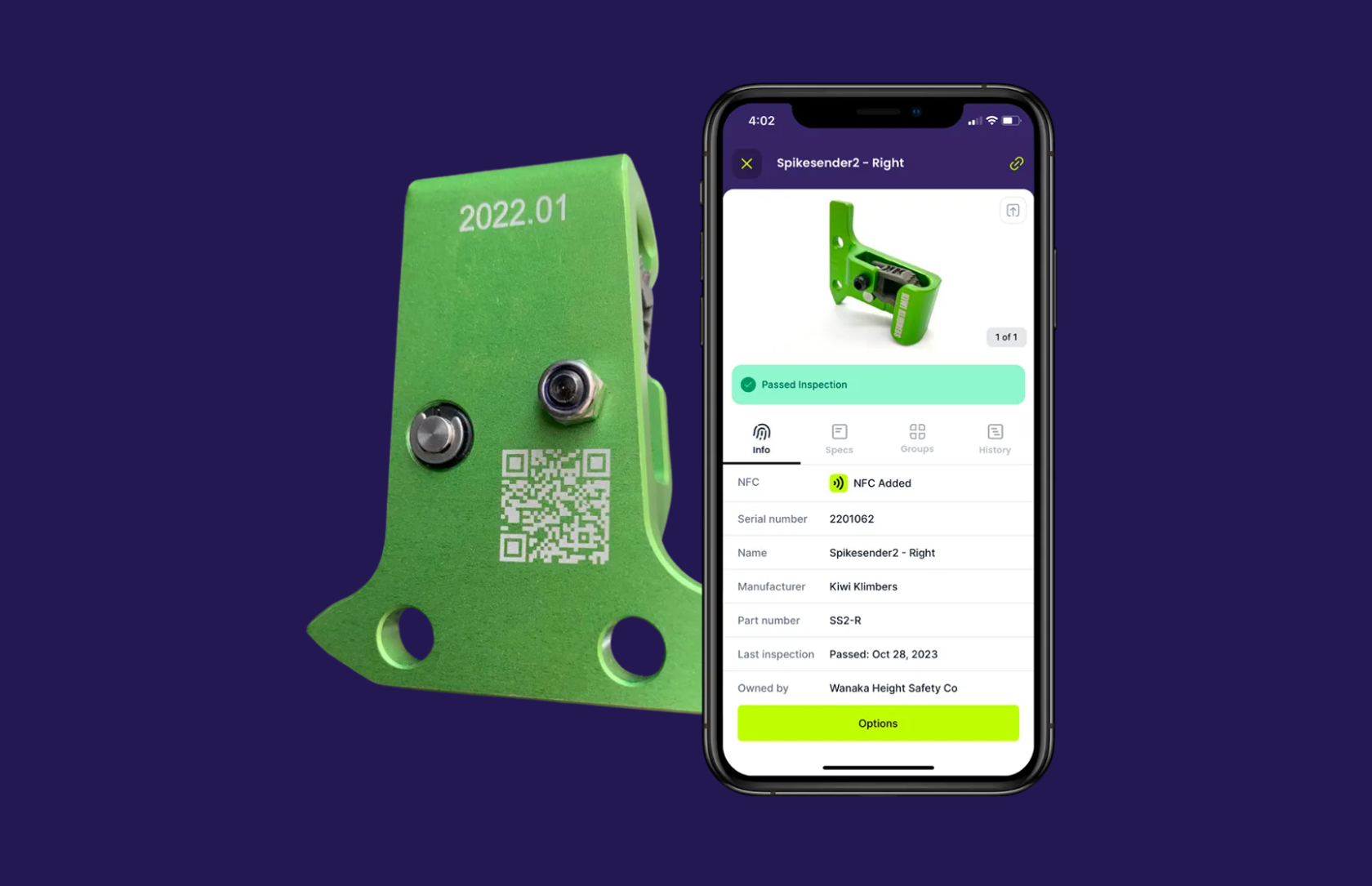
Strip away the regulatory language, and a Digital Product Passport is a simple idea: every product gets a digital twin. A machine-readable record tied to the physical item that carries verified information about what it is, where it came from, what it's made of, how it should be used, when it was inspected, and what happens to it at its end of life.
You access it through a data carrier on the product itself — typically a QR code, NFC chip, or similar. Scan the item, get the passport. The data lives in a shared infrastructure that manufacturers, regulators, supply chain partners, and end users can all read from (with appropriate permissions).
The legal backbone is the EU's Ecodesign for Sustainable Products Regulation (ESPR), which formally entered into force in July 2024. From there, individual product categories are being phased in through delegated acts — initial enforcement begins in 2026, with additional product groups added through 2030. Priority categories include batteries, iron and steel, textiles, furniture, electronics and tyres.
The goals stack up like this:
That's the ESPR backbone. But DPP-style requirements are already showing up in other EU regulations too — the recently published EU Toy Safety Regulation explicitly includes DPP obligations, and similar mechanisms are baked into both the EU Battery Regulation and the Construction Products Regulation.
The pattern is clear. DPP is becoming the default architecture for product-level data in the EU. Not a bolt-on or one-off compliance project, but the way products are documented from now on.
Based on our understanding right now, yes — though the path isn't as direct as people assume.
PPE isn't named in the first wave of ESPR delegated acts. In fact, the current draft textile delegated act explicitly excludes smart textiles, PPE, medical devices, and raw textile materials from its scope.
A few things to understand:
So what does this mean in practice? PPE will not be in the first cohort of mandated DPP categories, but it will likely land in the second or third.
You’re perhaps wondering if you should care about the DPP if you manage safety equipment, because it feels like it’s written for manufacturers. And you’d be right in thinking so. But if you think about how this shift impacts how you interact with your gear in the future, it actually opens up a lot of opportunities for efficiency, traceability and compliance.
If you're a safety manager, rope access manager, fire and rescue lead, supervisor, or anyone responsible for safety equipment in the field, here's what changes for you.
Today, the burden of safety equipment management lies on your side. You buy a harness. The manufacturer's data sheet lives in a PDF somewhere. The serial number gets typed (or mistyped) into a spreadsheet. Inspection records sit in another system, or on a clipboard, or in someone's head. Compliance documents are stored across email threads, shared drives, and filing cabinets.
When an auditor asks for the full history of a specific harness, you go hunting.
Under a DPP regime, that flips. Every compliant item will arrive with its own verified record — product specs, certification documents, expiry dates, inspection schedules, the lot. Scan the tag. The data is there. Not data you entered. Data the manufacturer put in, that you and the inspector and everyone else can trust.
This is the bigger shift. A DPP isn't a static document — it's a live record across the product's life. Inspections, repairs, retirements, changes of ownership — those events get written back to the passport. The product's history is its own evidence.
For Equipment Owners, this means:
If you're still running on paper or a spreadsheet, the DPP transition won't break anything tomorrow. But the gap between what your gear is capable of telling you and what your system is capable of capturing is at risk of widening in the future.
And this is exactly why we’re working with more, and more manufacturers to help them create Smart PPE™.
We’re working with over 50+ manufacturers to build in the technology at the point of manufacture. What that means for you is that there'llthey’ll be even less need for you to rely on retrofitting your products with NFC tags, because it’ll already have that built in.
A quick tap of the phone, or scan of a data matrix will pull up all the information you need to know about a product. Part number, batch number, instructions, certifications, load ratings – everything that’s important to you, and required, is there. And this is where the Scannable app comes in too – not only are we leading the way in Smart PPE production, our app is the easiest way to inspect, track and manage your safety equipment so you can keep everything in one place.
The manufacturers building DPP-ready PPE are already on the journey with us. See who's leading the Smart PPE transition, what they're producing, and how the next generation of safety equipment is being built.
Explore the manufacturers already creating Smart PPE™ with Scannable.
