
Smart products have existed in the world of personal protective equipment (PPE) and safety equipment for a while now.
Think sensor-laden helmets, biometric patches, and gas detectors that ping your phone when something goes wrong — wearable safety gear that integrates sensors, AI, and wireless communication to primarily monitor workers and their environments in real time. All are great uses of technology and ultimately designed to keep people safe in high-risk environments, but they’re really designed for hazardous environments where air quality and working environments need to be kept tabs on. But that’s barely scratching the surface of how Smart PPE can benefit people working in high-risk environments.
The world of height safety comes with equally as stringent compliance requirements. Whether you're servicing a wind farm, hanging off the side of a high-rise performing maintenance, or dropping off the side of an oil rig, you need to trust your gear, and trusting your gear means knowing it’s safe to use. We’re seeing the shift of more manufacturers moving towards equipment with digital traceability built in at the point of manufacture. A harness that knows its own service history. A lanyard with a tap-to-verify digital identity. Gear that carries its compliance record for life.
Smart PPE is a definition adopted by both camps, but it’s worth calling out the nuance depending on the type of equipment.
Sensor-based Smart PPE is mostly what we see today. Hard hats with impact sensors. Vests that monitor heart rate and core temperature. Boots that detect falls. Gas detection wearables that radio a control room. The easiest way to think about this category of Smart PPE is by thinking about the smart watch you wear on your wrist – it’s a similar logic but applied to safety equipment in high-risk environments.
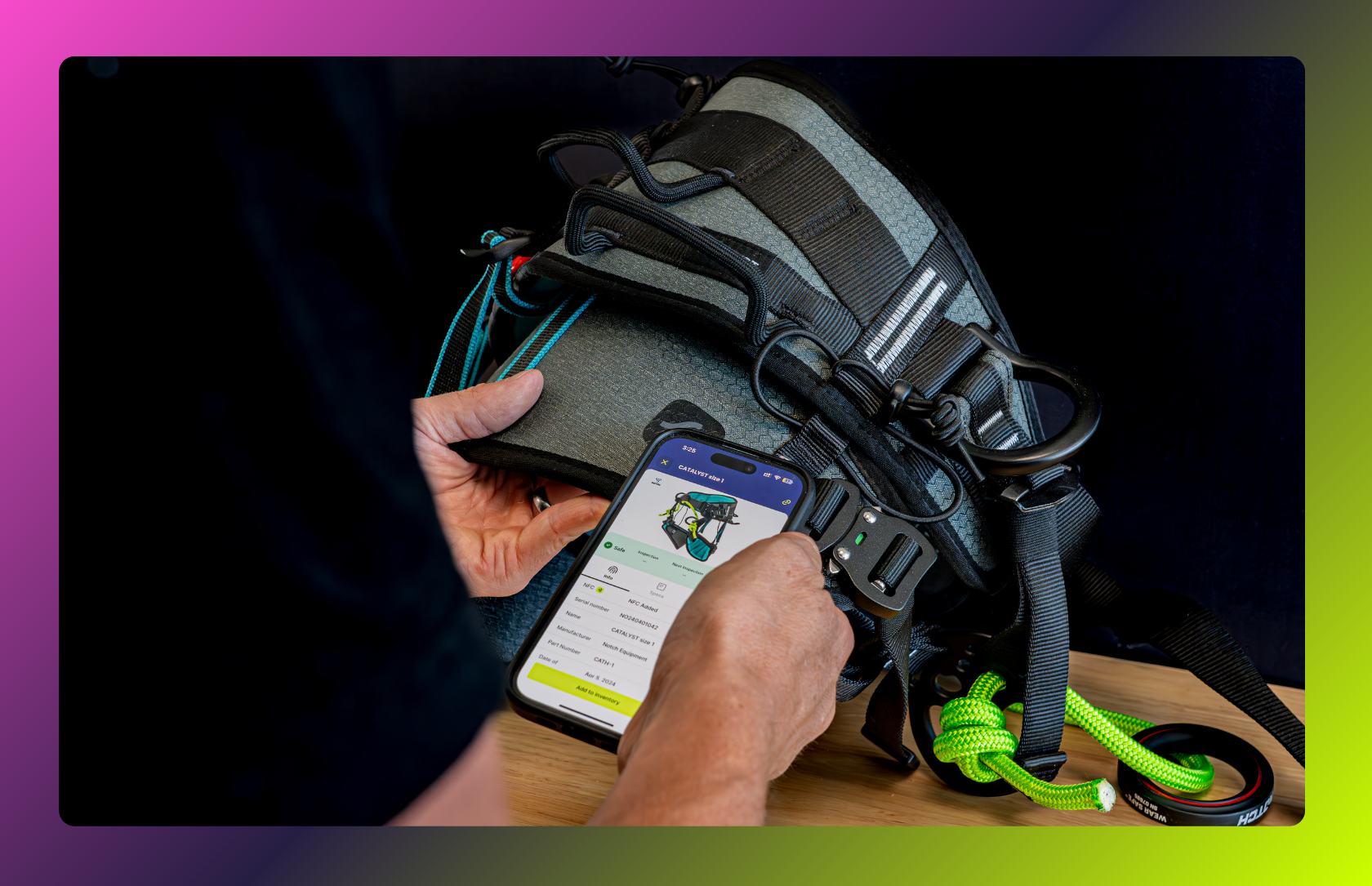
Traceability-based Smart PPE is different. The "smart" part isn't a sensor on the wearer — it's the digital identity of the gear itself. Each piece of equipment has a unique identifier (NFC, QR, RFID, or data matrix) that links to a complete digital record: manufacturer, batch, inspection history, service life, compliance certifications, recall status. This is more about maintaining traceability of your gear and knowing it’s safe to use when heading out into the field , as opposed to having it tell you (or your team) when air quality conditions hit a certain threshold.
Two fantastic applications of technology to keep workers safe, but two different challenges being solved for.
Adopting technology along with PPE is nothing new; it's been "the future" for over ten years now.
Wearables have brought real benefits to industries like oil and gas, mining, and large utilities.
But for the broader PPE-using world — rope access teams, height safety operators, rescue teams, tree care specialists — sensor-based Smart PPE doesn’t always fit the bill.
The traceability version of Smart PPE solves a problem everyone has, not just a problem some people have.
Every piece of critical PPE – we’re talking harnesses, lanyards, helmets, connectors, lifting gear – needs to be inspected, recorded, and monitored to ensure it’s fit to be used in the field. The compliance requirements vary by region but it's what LOLER, IRATA, OSHA, WHS, and CE/UKCA standards all require in one form or another. The problem Smart PPE solves isn't whether teams know to manage their equipment; it addresses how they've been doing it.
Traditionally, tracking gear has meant (we hear this daily at Scannable):
Meanwhile, the manufacturer holds the full data — batch numbers, test certificates, material specs — but none of it travels with the product into the field. When a recall happens, when an audit lands, when gear changes hands, the paper trail gets light.
Smart PPE closes that gap. The gear carries its own identity. With Scannable technology built in, inspection results are recorded on a phone, against the specific item, with timestamped records. Recalls become a targeted action instead of panic. Audits become a tap-and-show instead of having to go through mountains of folders and paper.
The reasons for purchasing Smart PPE, and adopting a tool like Scannable for managing your equipment are only getting stronger. NFC technology is now something we use multiple times a day (think contactless credit card payments), which in turn means our mobile phone is now all we need for management of our safety gear. This reduces the barrier to entry for teams in the field, and also helps keep the cost down for adoption at scale.
There's another reason that Smart PPE, and traceability is going to become more important.
The EU's Ecodesign for Sustainable Products Regulation (ESPR) — in force since July 2024 — introduces the Digital Product Passport (DPP). By 2027, most products sold into the EU will need to carry a machine-readable digital record containing lifecycle, sustainability, and compliance data. Textiles, batteries, and electronics are first on the rollout. PPE categories are also included. The US and Canada are watching closely and following, particularly as it impacts any equipment manufacturer who exports to Europe. At Scannable, we view the DPP as the impetus for global safety equipment manufacturers to make the shift towards producing Smart PPE™.
The idea is that every product carries a unique link, through some form of data carrier, such as a QR code, or barcode attached to the product itself.
These are just two of the ways that Smart PPE™ is already being produced today. We’ll be as bold to say that DPP-compliant PPE is Smart PPE™.
To summarise what this means in practice:
Any manufacturer selling into the EU over the next three to five years will have to produce PPE with embedded digital traceability anyway. Manufacturers who treat that as a compliance box to tick will produce the minimum. Manufacturers who treat it as a product feature — a reason to buy their gear over a competitor's — will build the next generation of Smart PPE™ from day one.
If you own safety equipment — as a company, a team, or a contractor — the shift to Smart PPE™ affects you in three concrete ways:.
1. Inspections get faster and more defensible. Tap a harness, pull up its full inspection history, and document the current inspection against the exact item you're holding. No more reconciling spreadsheets. No more "which harness is serial 4827 again?"
2. Recalls stop being a nightmare. When a manufacturer issues a batch recall, and you’re using a tool like Scannable, we’ll be able to automatically mark it as unsafe, and alert you in real time.
3. The economics of retrofit vs. built-in shift. Right now, most teams adopting digital PPE tracking are retrofitting — adding NFC tags to gear they already own. That works. It's how Scannable customers tag harnesses, lifting gear, and rescue kit today using rope tags, carabiner tags, grommet tags, sew-in labels, and approved-adhesive NFC stickers. But it's an extra step. As more manufacturers ship Smart PPE™, powered by Scannable, with traceability built in at manufacture, the retrofit step disappears. The gear arrives ready to upload to your Scannable inventory straight away.
All benefits aside, essentially, Smart PPE™ is PPE with a persistent digital identity. That identity carries compliance, traceability, and lifecycle data from manufacture to disposal. It's accessed through a tap or a scan.
Sensor-based wearables will continue to exist, and in specific high-hazard settings they'll continue to be critical.
But at Scannable we’re about designing for the other world too. Where any team working at height can inspect, track and manage their safety equipment in the most efficient way possible. Part of that is supporting the existing world we are in today, and the the other part is working with manufacturers of Smart PPE™ to make it smart right at the point of manufacture.
The gap between running safety equipment tracking on spreadsheets and where the industry is heading is widening every quarter, but the good news is that it doesn’t require starting again. It starts with tagging the gear you already own, and then choosing Smart PPE™- ready manufacturers when it’s time to replace it.
We’re already working with 30+ manufacturers of equipment today to create Smart PPE™, with more coming online in the future. Check out the whole range on our Smart PPE™ directory, and if you want to see how Scannable can support your equipment management journey, create a free account to get started.
